|
Dick's Bluegrass
Odyssey Volume 2 |
|
| Related Links | |
| Chapters 1 - 4 Chapters 5 - 8 Chapters 9 - 12 Chapters 13 - 16 | |
|
The first five chapters of this series originally appeared in the Fresno Folklore Society Flyer. It was decided to discontinue publishing them and make them available only on line. It should be noted that information about most of these festivals has been included in my travel reports. But those pages were written for a general audience, while this series is aimed specifically at fans of folk music. --Dick Estel, September 2026 |
|
|
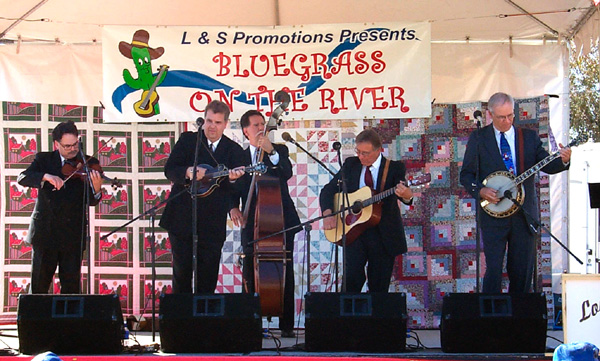
My Bluegrass Odyssey Chapter 5 Chapter 6 Chapter 7 Chapter 8 by Dick Estel Starting in 2003 and for several years after, I attended between three and five festivals each year. I met people who wished they could do it every weekend, but that sounded like “too much of a good thing.” I enjoyed every festival, combined some with other travels, and did some exploring of the areas near the festivals. The year 2003 kicked off with the first in a series of festivals produced by L & S Promotions, which was run by Larry and Sondra Baker from the northern California foothills. It was called Bluegrass on the River, and held in early March at La Paz County Park just outside Parker, Arizona, right on the Colorado River. When I arrived at the festival site, I had already been in Arizona for a number of days – I had been visiting my parents, who spent each winter in Mesa, where they owned a small mobile home in a park frequented by “snowbirds.” The scheduling for this festival was a bit different from most – there were no evening programs. This was ideal for those who wanted more jamming time, and people who could no longer stay out way past midnight (including Yours Truly). Following my usual plan, I arrived on Wednesday, and on Thursday drove up Arizona Route 95 to Parker Dam, which forms Lake Havasu. On the way back I stopped and walked up a wash in the hills south of the highway (opposite the river). It was easy walking, with lots of palo verde, mesquite and creosote bush, and cholla and barrel cactus. The first part of the wash was pretty level, then it started climbing slightly, but was still easy going. I probably went up a quarter to a half mile, and could have kept going. Where I turned back the canyon was getting pretty narrow, but was still passable, at least as far as the next bend. During the times when I was on festival grounds but there were no formal performances, I occupied myself by chatting with other fans, listening to jams, and of course, eating. With a complete kitchen in my RV, I brought most of my meals, but there are always food booths available, and I occasionally took a break from cooking and tried the various items offered. There are also booths selling crafts, CDs, clothing (including the mandatory festival t-shirts and sweat shirts), musical instruments, and various other items. The program got under way at 10 a.m. Friday with Pacific Crest, a group out of Bakersfield. That day also brought us three familiar bands, Ron Spears & Within Tradition, Lost Highway, and the Cherryholmes Family. However, the great revelation at this event was the U.S. Navy Band Country Current. The top level military service bands have many, many talented musicians to choose from, so the premiere groups are guaranteed to be outstanding, and Country Current certainly met that definition. Lead singer and guitarist Wayne Taylor would eventually retire and go on to form an excellent “civilian” band that I was also privileged to see. While still on active duty he recorded a solo album. The military would not allow him to promote it at the festival, but the M.C. handled that task. Along with 4,000 others, I greatly enjoyed this well-organized festival, and looked forward to others that L & S produced. I got started home about 8:30 Monday (7:30 California time) and drove all the way home, arriving about 7 p.m. It was a record distance for me, 456 miles, but it did not make sense to stop early in the day at the half-way point, nor to pay $25 to spend the night in Bakersfield, so I just kept going. The structure and format of a bluegrass festival is pretty well formalized, standardized and choreographed. There are two non-performers who are essential to the success of any festival. The Master of Ceremonies introduces the groups and talks, tells jokes and makes announcements between sets. One of my favorites, who served at least six festivals I attended, was T. J. Lyons, musician, iron worker and at that time, president of SWABA. He was friendly and outgoing, major qualifications for the job. Even more essential is the sound crew. They arrive at least one or two days before the festival, set up speakers and microphones, run cable, and hook up a huge mixing board. Their job is to make sure the performers can hear themselves and each other in proper balance through the stage monitors, and that the sound is right for the audience. Between sets they rearrange microphones and adjust levels, but the job is not done. Since volume varies, singers shift around, and microphones get bumped, they must stand ready to tweak the sound any number of times during a set. With only one or two exceptions at festivals I attended, the sound was excellent and the operators were all highly skilled. If you saw that the sound crew was Old Blue Sound of Colorado, or Paul Knight of the Bay Area, you knew you were in good hands. The performances usually start right on time, and each group plays for 40 to 50 minutes. During the intermission, the MC does his thing and the sound crew sets up for the next group. There are no prima donnas in bluegrass, so the group just does the sound check right there in full view…no one descends from the wings on a rope. Prices are very reasonable – the Huck Finn festival in 2004 was $50 for the three days, plus Thursday, Friday and Saturday night camping fees. Electricity is available at some events, and requires an additional charge. No festival offers sewer hookups, although some are in a place that has a sewer dump. There are usually but not always water hookups, and it’s often first come, first served for electrical and water. Some take reservations for electrical service. The festival at Parker AZ in March had no hookups of any kind, so was fully dry camping. There are still three more 2003 festivals to cover. Read on below. |
|
 |
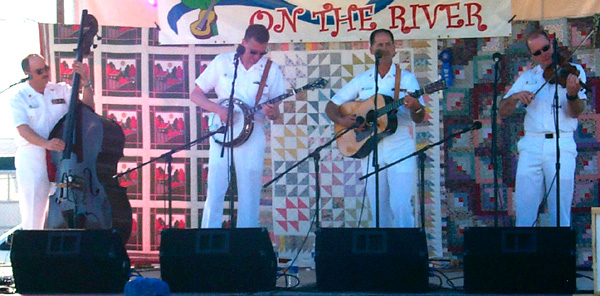 |
| Lost Highway | U.S. Navy Band Country Current |
|
Chapter 6 Chapter 5 Chapter 7 Chapter 8 When the festival in Parker AZ ended, I was already looking forward to the 2003 Parkfield Festival, coming up in May. As I would for most festivals I attended in the next 16 years, I took my travel trailer on the 100-mile drive from Fresno to Parkfield. The week before the festival was rodeo weekend, and they had two inches of rain. The road from the main street to the rodeo grounds is dirt, so a lot of mud got moved around – so much that the main paved street looked like a dirt road when I arrived. I usually arrived on Wednesday, so that I could explore the surroundings on Thursday, when there was jamming but no stage show. Vehicles had created deep ruts in some parts of the grassy camp area near the stage, but I got set up in a fairly dry, solid spot, with water and electricity. I got acquainted with Ted and Ida, my next door neighbors. They had a band that played “folkgrass” in Twain Harte, and sounded very good together. During that first evening they were joined by dobro player Ivan Rosenberg, who I had visited in Missoula, Montana, the previous summer. Since grandson Mikie was now in kindergarten, he and his mother did not come with me, but instead drove over Friday when he got out of school at 11:30. They arrived during the first group's performance, so did not miss much. New to me this year were Chris Stuart & Backcountry, based in San Diego. Over the next few years I got to know Chris pretty well, and discovered that he was an outstanding songwriter, having issued four excellent CDs by 2009. He was joined by a highly skilled singer and banjo player, Janet Beazley, who also produced a delightful solo album, and by Ivan on the Dobro. I’ve briefly mentioned Lost Highway, but they deserve a few more words. The original band was formed in 1974, but had disbanded in 1987. In 1996 former members Ken Orrick and Jeff Harvey revived the group, with Dick Brown on banjo, Paul Shelasky on fiddle, and Marshall Andrews on bass. Over the next few years there were various changes in the line-up, most significantly the addition of multi-talented singer-guitarist Eric Uglam. I would have several enjoyable conversations with Dick and Eric over the years, as they moved on to other groups. Paul was well-known for his involvement with the Good Old Persons in the Bay Area, and had written the show-stopping song, Rutabaga Boogie. It’s well worth investigating on You Tube here and here. Lost Highway attained some national attention, and were successful enough to acquire a big tour bus by the time of the 2003 festival. Sadly, Ken developed health problems and died in 2009 at the age of 68. This was essentially the end of Lost Highway, but of course, its members continued to play in other combos. Paul appeared with a group at Bluegrass in the Park in Clovis in 2025. Barely a month later I was off to Victorville and the 27th annual Huck Finn Jubilee, which I would attend a total of three times. This is in the high Mojave Desert, but the setting is quite nice - Mojave Narrows Park. The Mojave River flows north from the San Bernardino mountains, disappearing about 50 miles from the Nevada border. It flows underground most of the way, but comes up for air in this area, creating a wide river valley with lots of grass and trees. This event is on Father’s Day weekend, the same dates as CBA’s festival at the Amador County fairgrounds in Grass Valley. Both of these festivals feature some of the biggest names in bluegrass, with some of the same artists appearing at both events. This year’s festivals featured Rhonda Vincent, who is considered the number one female artist in Bluegrass; Doyle Lawson and Quicksilver, a veteran group with many popular CDs; award-winning Blue Highway, the Del McCoury Band, and Patty Loveless. Patty was better known as a contemporary country artist, but had huge success with an acoustic, semi-bluegrass CD that she released around the beginning of 2002. McCoury played with Bill Monroe, and his own group is still going strong. Doyle Lawson’s group proved to be the best at the festival, and in fact, the best I had seen anywhere. New to me and very good were Karl Shiftlett and Big Country. They were a great “in-person” band and I would see them several times over the years. My verdict at the time was that they were just one steel guitar away from being country. The big groups Saturday were Rhonda Vincent and Blue Highway. I had never seen either group, but had several of their CDs. Rhonda was in her family’s band, The Sally Mountain Show, and I have a videotape of their appearance on Fire on the Mountain, a show that was on The Nashville Network in the 1980s, featuring bluegrass and traditional music. I had not heard of her as a solo act till a couple of years previously when she started getting a lot of attention. Blue Highway had started up about ten years previously, and I bought one of their CDs after reading about them in a bluegrass magazine. Both groups were outstanding, giving clear evidence of why they are considered at the top of their profession. The big events Sunday were a rare west coast appearance by the Del McCoury Band, and a closing show by country star Patty Loveless. She is an honest-to-goodness coal miner’s daughter and grew up listening to the Stanley Brothers, Flatt & Scruggs, and other bluegrass pioneers. Patty did the first half of her show featuring songs from the Mountain Soul CD, performed on acoustic instruments. The band then switched to electric guitars, drums, keyboards, etc. and got very loud. A number of people who had been sitting in the first ten rows or so, including myself, moved to the back to avoid hearing damage. The music was good, just too loud up close. With this event in the rear view mirror, there was one more event in 2003, another trip to Logandale in Nevada. Again I included a visit to a national park in this trip – my first time at the Grand Canyon. It was most convenient to go to the North Rim, since a South Rim trip would have added a couple of hundred miles to my drive. The visitor center and all businesses on the north side were closing October 15, and the festival was the 10th through 12th, cutting it too close to go afterward, so I went straight to the canyon, with an overnight stop at an RV park in North Las Vegas. I stayed at Jacob Lake, about 45 miles from the rim, and drove into the park in my truck two days. My visit to this amazing spot was everything I could have hoped, and I could write a lengthy report on just that. In fact I have, and it’s on line here . A second visit there in 2015 is also detailed here. But back to bluegrass. I returned from Arizona to eastern Nevada and got set up at the fairgrounds in Logandale. Danny and Sherry from Salt Lake were there, as was another couple I had met the previous year, Lonnie and Halene, so we chatted and played a little, and listened to some other people picking. Since Thursday is a “dead day” with no performances, I made a second trip to the Valley of Fire State Park. I walked on a 1.5 mile loop trail that goes out from the entrance station, past a lot of dramatic rock formations, including several that look like animals or faces. For the first time in my life I saw a horned toad (actually a lizard). I saw something that looked like a big bug zipping across the trail, and when I knelt down it took me a while to find him. He sat completely still while I studied him and took a picture. He was quite round, about the size of a quarter, with a tail that seemed more like a turtle than a lizard. He had spines on the side of his body and across his brow. The on-stage line-up was one of the best aside from the Huck Finn Jubilee. Each festival I see new groups and usually find one that I really like. This time both of my new favorites were bands from Colorado – Open Road and High Plains Tradition. The latter was especially good, and I bought one of their CDs. Often a CD does not capture the band’s energy and sound that you experience live, but this collection is good from start to finish. Open Road is a very young band. The lead singer has a nice voice, but it will probably be a really good voice when he gets to be 35 or 40. Old favorites included Lost Highway, who I had seen a number of times, starting with some of my first festivals in Mariposa. Another group that was at the festival the previous year, the Liberty Bluegrass Boys from Texas, also proved to be as good as I thought they were. I also heard a bunch of songs I had never heard before, both on stage and in the parking lot jams (if I had heard them before, they hadn’t registered). It always amazes me how people come up with great, unfamiliar songs that have been done by well-known artists such as Flatt & Scruggs, Hank Williams or Waylon Jennings, as well as obscure great songs by obscure artists (Examples: Waylon’s “Wrong,” Hank’s “I Told My Heart a Lie,” and in the double obscure category, “Roseville Fair” by Bill Staines. Of course, I know that many FFS members would tell me that Bill is NOT obscure. I stayed in Mojave on the way home, which brings me to a final food-related note: If you’re in this area and want to eat, skip the Denny’s and McDonald’s in Mojave and Barstow, and try the Roadhouse Café at Kramer Junction (where US 395 crosses California 58). It has good food and good service, and while you’re at it, you can buy gas on all four corners. Highway 58 now bypasses Kramer Junction, but still has access. |
|
 |
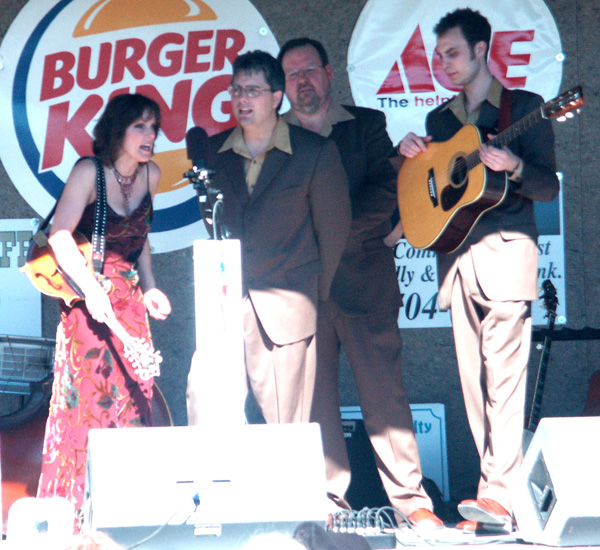 |
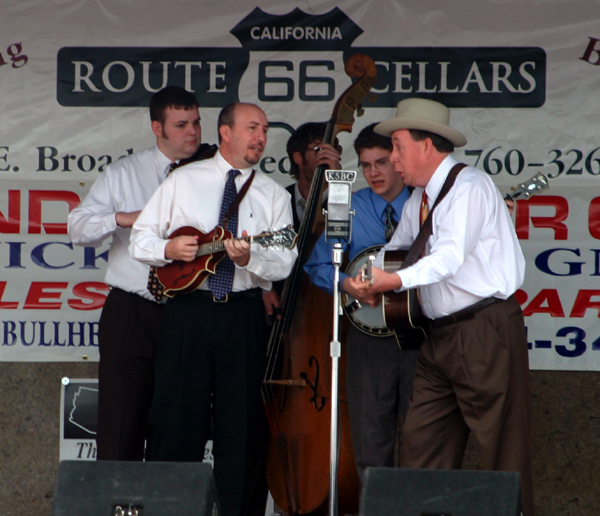
| Karl Shiflett | Rhonda Vincent |
|
Chapter 7 Chapter 5 Chapter 6 Chapter 8 The next year, 2004, saw me attending four festivals that were new to me, plus an “old favorite.” But first, a few words about one of the particularly fun things about these events, the next generation. Like all human societies, the bluegrass community must produce a continuing supply of new musicians and fans to keep the music going. I’m not sure (and maybe no one is) where the first one of these projects took place, but at many festivals in California it came to be known as Kids on Bluegrass (and sometimes Kids on Stage). A long-time fan and sometime performer, Frank Solivan, is generally credited with getting it going in California. Kids who want to perform sign up at the start of the festival, and attend a number of workshops. This is not meant to teach them how to play; they are expected to have a basic skill level. The plan instead is to guide them in how to play with others and how to comport themselves on stage, Usually on the last day of the festival there is a slot on the main stage devoted to a performance by all the kids who went through Frank’s workshops. Does it work? One of the first Kids was Frank’s son Frank II. He eventually played with the Navy Band for several years, and then formed his own combo. The first festival of the year for me came early, and I combined it with a visit to my parents. They had a mobile home in Mesa AZ where they spent the winters, and on my way there, I stopped at Bullhead City AZ for the 4th annual Colorado River Bluegrass Festival, my first time at this event. The festival site was a public campground right on the river, by the bridge to Laughlin NV, so we had the amusing sight of old time bluegrass music on one side and the high rise casinos of Nevada on the other.. The festival was loaded with big name acts, including Rhonda Vincent, James King, Doyle Lawson and Lost & Found. As usual there were some I’d seen, some I’d heard of but not yet seen, and some that were new to me. The Friday and Saturday shows ended at 5:30 p.m., but uniquely some of the artists crossed the river and performed in a casino at 8 p.m. This allowed fans to get out of the wind and cold that prevailed much of the time. I did not attend these shows, but admission was a very reasonable $5 (not counting the temptation of nearby slot machines and blackjack tables). As always, there were a couple of groups I liked very much that were new to me – Lost & Found, which has been around for 30 years, and the Chapman’s, a father and three sons, the oldest being 25 at the time. Both of these groups have had considerable success with their recordings and appearances. Lost & Found was launched in 1973, and still had two original members – Allen Mills and Dempsey Young. They started getting national attention in 1980 when they signed their first record contract. Two songs on their second album became bluegrass standards – Wild Mountain Flowers for Mary and Love of the Mountains. On top of his lead vocals, Mills delighted the audience with tales of his part of the country and the Bluegrass Parkway in central Kentucky. He even gave the location of his home along that road and invited fans to drop by. Probably anyone taking up the offer would have found him out on the road. (Sadly, Allen passed in 2026 at age 88.) It’s impossible to overstate the value of Doyle Lawson to the bluegrass scene. He refers to his band, Quicksilver, as “the farm team for bluegrass,” because so many players have moved on to individual success. Jamie Dailey, guitar player when I saw the group, is a shining example. He “graduated” and hooked up with Darrin Vincent (Rhonda’s brother) to form a very successful duo. They’ve produced a number of standout albums and have a regular TV show on RFD-TV. (A live concert scheduled for July 2026 at the Tower Theater in Fresno was mostly sold out as this was written in April.) Doyle himself passed through the bands of Jimmy Martin and J. D. Crowe before going out on his own. I could go on and on about other groups, but perhaps it’s best that I move on. From Bullhead City I headed for Mesa, just east of Phoenix, where my parents were spending the winter, and set up my trailer in the same park. There was a bluegrass festival coming up at the Apache Junction fairgrounds, east of Mesa, so I decided to go just on Saturday. There were five groups appearing on Saturday, each one doing two sets. I had seen only one of the groups before, and all were good. On top of the list was The Lonesome River Band, which was already one of the bigger names in bluegrass. I have several of their CDs, and they immediately became one of my favorite groups to see live. Another widely known group, Special Consensus, was in its 29th year. Founded in Chicago by Greg Cahill, it has seen a rotating list of members come and go over the years, with the talent quality always high and Cahill’s banjo a constant. I had heard about Pine Mountain Railroad on the Internet and bought their CD; they also put on a great in person show. They had a huge diesel bus with an ad for Tennessee Pride Country Sausage painted on the side. It was a bit odd to be at a festival without my personal “house” nearby. When nature calls, being able to head for the trailer is several levels above the port-a-potties provided at most festivals. I survived this minor inconvenience, and also enjoyed getting my lunch from one of the venders instead of making do with a peanut butter sandwich. There were still three festivals to go, the next one sort of new and sort of not. The people who put on the annual Camp Rude festival at Parkfield turned it over to another couple, who changed it to the Mid-State Bluegrass Festival, moved it to Paso Robles, and set it for one week earlier. Some other people, who have enjoyed visiting Parkfield every Mother’s Day weekend, started a new festival there, so although it’s the same place and same weekend, it’s not the same festival. If you’re fully confused, just forget all the above and read on. On Thursday, the day before the Mid-State festival started, I drove to the coast and made my first visit to Hearst Castle. It was even more impressive than I expected, and I would return for a second visit less than a week later. There are four separate tours; you can’t possibly see everything in one visit. The music started Friday morning and I saw several familiar groups, including the ever-energetic Lampkins Family and Ron Spears & Within Tradition. The best surprise was the Bear Ridge Bluegrass Band, which was kind of an informal ad hoc group that had a killer female singer and were very good overall. The Internet has no information about them, so I think they were truly a one-off group. A band I had seen before deserves mention here. Sidesaddle and Company got started in 1979 and are ably led by Kim Elking of Hollister. They are a co-ed band, with three gals and two guys and put on a top-level show. I’ll give a quick mention of Brothers Barton, Paul and Loren from Bakersfield, plus a couple of unrelated “brothers” to fill out the band. I saw them at least two different times and rated them above average. Teri and Mikie came over in time for supper and the evening show. His “bluegrass grandparents,” Rad and Tele from the first Parkfield festival were there and Rad even helped Mikie catch a lizard. On Sunday Teri left for home, while I drove a short distance to an RV park in Atascadero. From there I would visit Hearst Castle a second time, then head for Parkfield. More about that in the next chapter. |
|
|
|
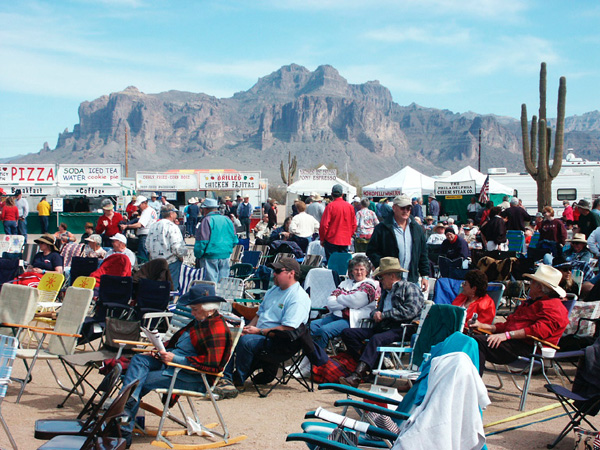
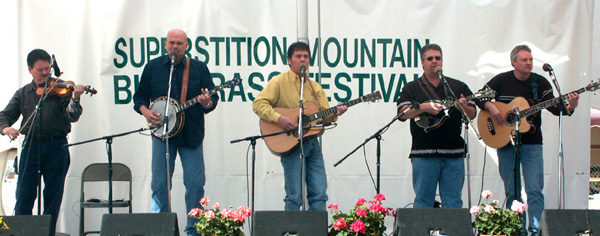
| The crowd at the Superstition Mountain Festival east of Phoenix | Lonesome River Band |
|
Chapter 8 Chapter 5 Chapter 6 Chapter 7 Having traveled to festivals and coastal cities and Hearst Castle, I finally made my last stop of this extended trip at Parkfield for the Mother’s Day festival. The music started on a Thursday, which was rare, but would become the standard for Parkfield. The people running the festival seemed to be really disorganized – the show started 45 minutes late; they didn’t have programs available; the MC appeared to have little idea what was going on, and had trouble announcing the groups even with notes in his hand. The music was good, so everything else was tolerable. The mediocre bands were just that, none of them bad, and there were two really good ones the first day. There were also some fairly well known national groups on the program. I did not document who those two groups were, and of course, I don’t have the program to refer to. I DO have the flier that was sent out in advance and handed out at other festivals, so I can discuss those well-known groups. The best band overall was the Fox Family. They were originally from upstate New York, and I had seen them at the Mariposa festival. By this time, they were based out of Nashville, and they were even better than I remembered. They had a new member with them, a young woman who played the fiddle, Apparently no one had warned her about California’s fickle May weather. She was wearing a short-sleeve t-shirt, and was still dressed that way for the evening performance. The nice warm day had become a VERY cool night, and she was obviously suffering, until a compassionate fan lent her a jacket. Also excellent was Chris Stuart and Backcountry, a fairly new band that had played at Parkfield the previous year. They had really come together well and were nearly on a par with the Fox Family. They had some personnel changes between the first and latest times I saw them, but settled into what I considered their “classic” lineup. This was guitarist Eric Uglam, singer, songwriter, record producer and former member of Lost Highway; Janet Beazley, banjo whiz from San Diego, and Eric’s stepsons, Austin (bass) and Christian Ward (fiddle). I first saw the boys when they were part of the “Kids on Stage” program. They were competent, but eventually became top level pros. This classic lineup can no longer exist, since Christian has recently been playing with Del McCoury. Over the years I would have several chances to chat with Chris Stuart, as well as enjoy his music. He is an excellent singer, songwriter and writer – one of those mostly unsung and under appreciated individuals who exist in all the various categories of human creativity. He wrote a number of articles for the magazine Bluegrass Unlimited, producing profiles of such luminaries as McCoury and California’s own Kathy Kallick. A few other groups that deserve mention included Virtual Strangers, Bean Creek and Leroy Mack, all of whom made a mark on the bluegrass scene back in the day. I could go into more detail, but I hear a small voice saying, “Move along, Dick.” At the Parkfield festival I talked with the couple who promoted the Paso Robles festival. He said that he lost money, mainly because they did not get very many day visitors. That festival was the first and last in that venue. This ended the winter-spring period of bluegrass for me, with one more festival in 2004, in (almost) the fall. In 2003 the Bakers, who had produced Bluegrass on the River at Parker in Arizona, revived a festival in Plymouth, site of the Amador County fairgrounds. The event returned in ‘04, and I attended for the first time. Plymouth is located on State Highway 49, a few miles north of Jackson between State Highway 88 and US 50. The campsite I was placed in was in a livestock barn – fortunately with no cows. The advantage of this location, besides having electric and water hook-ups, was having shade on my trailer and truck 24/7. Disadvantages included the need to use lights inside the trailer even in the daytime, and quite a few flies left over from fair time. My "official" bluegrass festival plan calls for me to arrive on Wednesday, with Thursday a day to explore the area. First I explored Plymouth, about a ten-minute job. The population was either 500 (according to the city limit sign) or 900 (according to a lady in city hall). Regardless, it is an incorporated city, one of the smallest in the state. But not the smallest, since nearby Amador City has about 210. As a good bluegrass fan, I felt I would be remiss if I did not drive to Fiddletown, six miles east of Plymouth, so I headed for that old mining town, which dates from 1849. During the Gold Rush, it reportedly had the largest Chinese population outside of San Francisco. It's a very small town, and there did not seem to be anything worth stopping for, so I continued on Fiddletown Road and made a loop back down to Highway 49 at Sutter Creek. Another two miles up the road is Amador City, where I stopped. I went to several antique stores, and found some good Christmas gift ideas. The music started on Friday, September 17. At an elevation of 1,000 feet, it was not surprising that it got up to 90 degrees. The next day was a completely different story. We woke up to find it overcast and cool, but with no threat of rain. It was very comfortable all day to wear long pants and a long sleeve shirt. It was clear most of the night, but Sunday morning was again cloudy, and rain started about the same time as the music. At first it was a gentle mist, but soon got to a point where I went to my trailer to dig out my umbrella and poncho. This did not really solve the problem, and a hard driving rain soon drove me back to my trailer, where I listened to some people who were jamming in the nice, dry barn. Around this time the musicians moved inside an exhibit building, and at noon the music started again. Of course, by this time the rain had stopped and it was looking fairly bright outside, but it soon started raining again, with a fairly strong storm lasting an hour. The weather notwithstanding, the music was good to excellent. Even a group that I did not care for before sounded pretty good, and there were several groups that were great. The best of those that I had never heard (or even heard of) was Cedar Hill. It was also my first exposure to a couple of nationally known groups, Honi Deaton and Dream, and the Mark Newton Band. Both were excellent. The best of the best were Karl Shiflett and Big Country, and the US Navy Band Country Current, both of whom I had seen before. Another pleasant surprise was Bluegrass Etc., a three piece group. The bass player was Bill Bryson, who I had seen with Laurel Canyon Band and the Grateful Dudes. He also had been in the Desert Rose Band with Chris Hillman, and was a session player with many big stars. This group was simply amazing for a three piece group. I also enjoyed John Murphy & Carolina Special, Silverado, Rick Jamison and Copper Canyon, The Lampkins Family, and banjo legend Tony Trischka. I had learned long ago not to let my mood detract from whatever else is going on around me, and the weather at my first Plymouth festival was not good for my mood (I HATE getting rained on). Even so, I would return to this venue five more times, and you’ll be reading about that later. In keeping with my practice of combining bluegrass with other travel destinations, after breakfast Monday, I hitched up and traveled 23 miles to Indian Grinding Rock State Park. This park is a few miles off CA 88, north of Pinegrove, which is just a few miles from Jackson, at the junction of 88 and 49. This park is well worth a visit, with a large outcropping of marbleized limestone with over 1,200 grinding holes made by the Miwok Indians who are native to the area. There is also a very nice Indian museum, and a reconstructed village with bark houses, acorn storage structures, and a large round house. The park website will tell you more, so I won’t. |
|
|
|
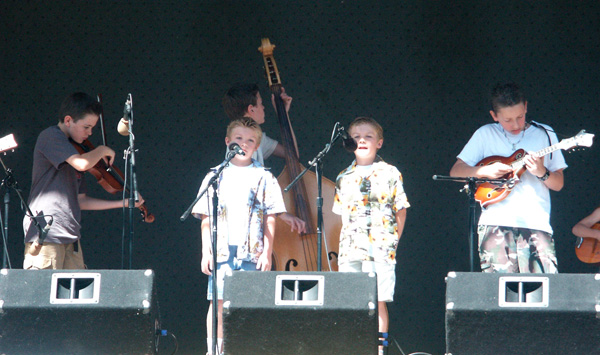
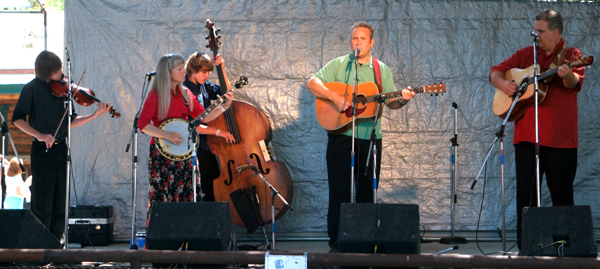
| Kids on Stage | Chris Stewart and Backcountry |
