|
Hockey Greats Just a few of the great players who retired or left the NHL since I started following the game... Click on the picture
to enlarge (photos open in a new window) |
|
|
A final word: This page had not been updated for a number of years. This is not to say that there aren't great player retiring on a regular basis. However, more and more I recognize that not only does each day have a finite amount of time to work on various projects, the overall time left to me has an unknown but irreversible cutoff date. Therefore I choose more carefully what I want to do with my time, and the information that would be added here is readily available elsewhere. We've seen the end of great careers such as Nicklas Lidstrom, Daniel Alfredson, Marty Bordeur (reluctantly and a bit too late) and the incredible Teemu Selanne. It's even possible that Jaromir Jagr will retire someday, although at age 42 he continues to move up the all-time scoring charts. He started the 2014-15 season at number 7 in goals, and has moved into 6th as of the 2015 All Star break. He needs nine more to climb into 5th, and 4th place would not be out of reach if returned next year. He'll be 43 in a few days, and there always seems to be a team willing to take a chance on him. By the way, he already left the NHL once, so he's listed below. Another ageless wonder if Jarome Iginla, who scored his 1200th point and 16th goal of the season for the Colorado Avalanche January 30. Of course, he's only 37, so his true "wonder years" may be ahead of him. --Dick Estel, January 2015 |
|
 |
 |
|
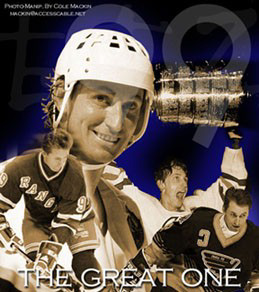
"The Great One," Wayne Gretzky, acknowledged as the greatest player in the history of hockey, played with style and passion for 20 years. On his way to shattering most of the league’s scoring records, he became the leading ambassador and spokesman for the game. In 1999, No. 99 retired, displaying the same quiet grace with which he played, after leading the New York Rangers in scoring for the season. During his final season he surpassed Gordie Howe for the most goals all time, including the NHL and the defunct World Hockey Association. On November 22, 1999, he was inducted into the Hockey Hall of Fame. In the 2000-01 season, Wayne stepped into an ownership position with the Phoenix Coyotes. From 2005 through 2009 he took over the coaching duties. Since that time he has not been affiliated with any team, but continues his role as an ambassador for the game.
|
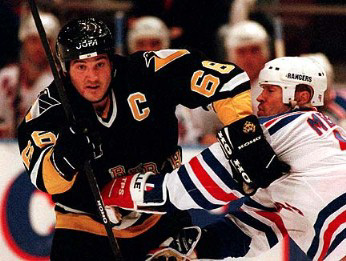
In 1997, The Hockey News, the world’s premier hockey magazine, commissioned a panel of experts to name the 50 best NHL players of all time. Mario Lemieux finished 4th, even as he announced his retirement from the game. With a relatively short career of 13 years (brought down by chronic back pain), Mario achieved two Stanley Cups with his only team, the Pittsburgh Penguins. He is widely credited with saving a faltering team with his sensational playing talent (he scored a goal on the first shift of his first game). In 1999, Super Mario again rescued the team, on the verge of bankruptcy, by exchanging over $20 million in deferred salary for a majority ownership of the team—the first former player to become a major sports league team owner. In 2000, Mario again played savior, by coming back from retirement - and scoring a goal and two assists in his first game back after nearly three years. Further health complications forced his final retirement at age 40 in 2006. In his ownership position, he garnered a third cup in 2009. |
|
|
|
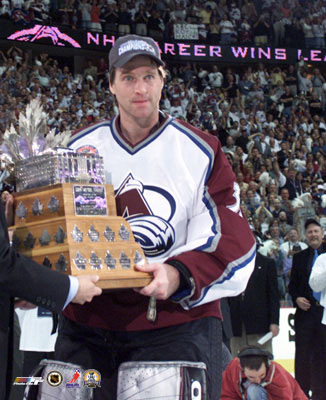
October 17, 2000, was St. Patrick's Day. On that day Patrick Roy won his 448th game, to pass Terry Sawchuck and take over the record for the most wins by a goalie in NHL history (since surpassed by Martin Brodeur). After starting his career by leading Montreal to a cup as a rookie, Roy developed a reputation for being able to beat you with both his mental and physical abilities. In addition to two cups in Montreal, he picked up another with the Avalanche in their first season in Colorado, and a fourth in 2001. Following the 2002-03 season, Roy announced his retirement. He left the game undisputedly rated as one of the top goalies of all time. He won four Stanley cups, and retired as the career leader in victories, games played, playoff games, playoff victories, and playoff shutouts. After several years as owner and coach of the Quebec Remparts in the Quebec Junior League, he returned to the Avalanche as coach in 2013-14, leading the team back to respectability and a playoff spot. |
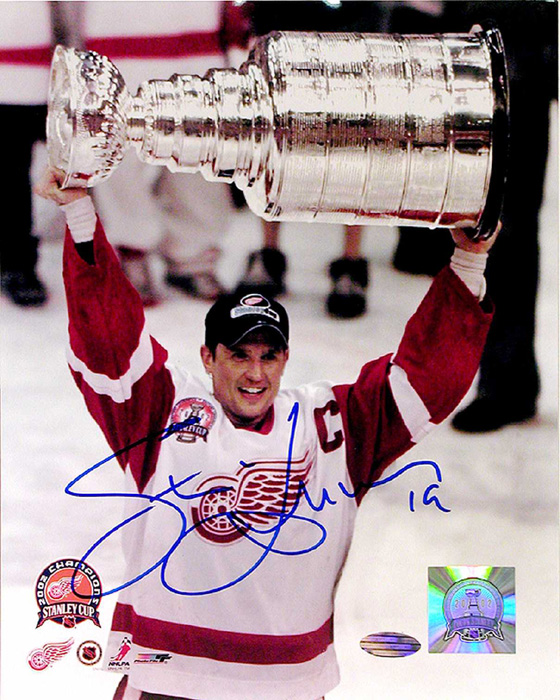
No one in NHL history wore the 'C' as long as Steve
Yzerman. He was captain of the Red Wings for 20 years, taking the helm
as a 21-year-old in 1986, and led Detroit
to three Stanley Cup titles. As an 18-year-old he scored 39 goals and 87
points in his first year. He went on to score 692 goals, 1,063 assists and
1,755 points in 1,514 NHL games. He retired after the 2005-06 season, and
his number 19 was retired. Along with three other undisputed greats, Brett
Hull, Luc Robitaille and Brian Leetch, he entered the Hall of Fame in
2009, the first year of eligibility for all four. He went on to a
continuing and successful career as general manager of the Tampa Bay
Lightning, as well as GM for the Olympic gold medal winning Canadian men's
team in 2014.
|
 |
 |
|
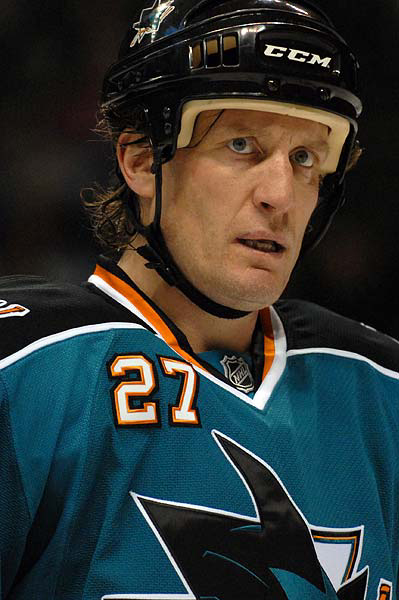
My first knowledge of Jeremy Roenick was when he joined the Phoenix Coyotes, which was my favorite team at the time. I was fortunate enough to attend a Phoenix game, and saw JR deliver one of those hits that makes the recipient suggest that the coach send someone else out next time Roenick is on the ice. I followed his career as he moved to Philadelphia, L.A., and back to Phoenix, so I was delighted when he signed with San Jose (my permanent favorite), where I got to see him a couple more times. I realize that he made his first big impact in Chicago, where he had a 53 goal season in 1991-92, but I'm glad he retired as a Shark. Never shy in expressing his opinions, JR backed up his mouth with passion on the ice, finishing his career with 513 regular season goals and 1216 points, plus 53 and 122 in the playoffs. His 1578 penalty minutes in 1517 games also attest to the meaning of "JR hockey." He continues to share his opinions as a broadcaster. He was born on January 17, 1970 in Boston, and was drafted eighth overall in 1988, after leading Thayer Academy to a high school championship, and skating for the US in the World Junior Championships that year. |
Although he became one of those players who "unretired," returning to the NHL to play with Philadelphia, Boston, Dallas and New Jersey, Jaromir Jager will no doubt hang up the skates some time in the next four or five years, so we're leaving him on this page. Born in the Czech Republic, he showed flashes of brilliance early in his career, skating alongside Lemieux in the Penguins’ Stanley Cup victories. Named captain of the club in 1998-99, he emerged as a solid leader, winning the Art Ross trophy for the most points in the regular season. He also captured the most valuable player award, as well as what many players feel is the most meaningful trophy of all, the Lester Pearson Award, player of the year as determined by vote of his fellow NHL players. In 1999-2000 he again captured the Ross, and entering the 2000-01 season was acknowledged by The Hockey News as the world's best. Prior to the 2001-02 season, he was traded to the Washington Capitols. Although it's felt he did not live up to his potential in the nation's capital, a trade to the New York Rangers in 03-04 eventually led to a revitalized career. He was credited with leading the Rangers back to the playoffs in 05-06 for the first time in several years. His improved play led The Hockey News to name him the number three player in the league. He played three seasons in Russia starting in the 2008-09 season. Following his triumphant return to the NHL in 2011, he scored his 700th goal in 2014, moving into 7th place all time, and is probably destined to finish 2013-14 no lower than 6th. Imagine where he'd be if not for his Russian sojourn. |
 |
 |
|
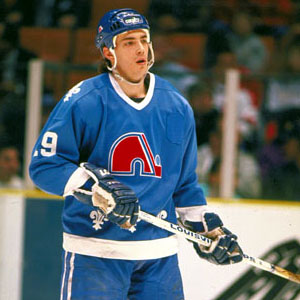
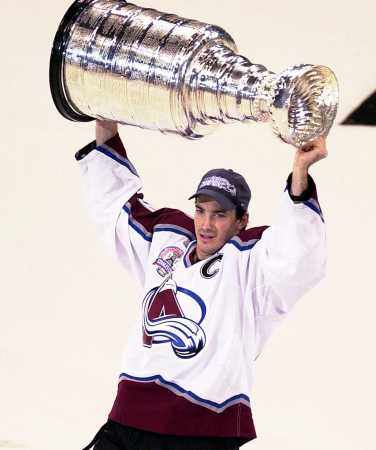
Joe Sakic was one of those rare modern players who spent his entire career with one franchise - the Quebec Nordiques/Colorado Avalanche. He became team captain in 1992, holding the honor until his retirement after the 2008-09 season. Joe led the team to the Stanley Cup in its first year in Colorado (1996), and won the honor again in 2001. During his 20 year career, he piled up 625 goals, holding the 14th spot all time in that category. He won league MVP honors in 2001, picked up an Olympic gold medal with Canada in 2002, and was voted into 13 NHL all star games. Born in Burnaby, B.C., Sakic settled on his future career when he attended Vancouver Canucks - Atlanta Flames game at age four. He had an outstanding career in junior hockey, and was drafted 15th overall by the Nordiques in 1987. He entered the Hockey Hall of Fame in his first year of eligibility, and returned to the Avalanche as head of hockey operations, bringing in Patrick Roy as coach and guiding the team back to the playoffs in 2013-14 for the first time since 2010. |
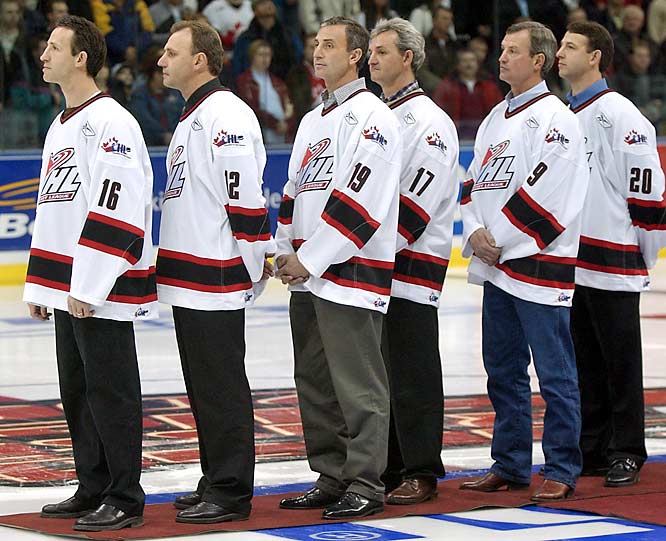
One of the most amazing and best known stories in the world of hockey is that of the Sutter Brothers - seven hard-working farm boys from Viking, Alberta, six of whom made it to the NHL. When I started watching hockey, only Ron was still playing, with the San Jose Sharks. But I have seen several of them serve as coaches and/or general managers, most notably Darryl, who helped bring the Sharks back to respectability. Eventually he moved on to Calgary, first as head coach, and finally as GM. Returning to coaching in Los Angeles, he guided the Kings to their first Stanley Cup win in 2012. Collectively the brothers played over 5,000 games and captured six Stanley Cups. Drafted by the Islanders, Brent Sutter had the greatest success, with 829 points in 111 games. Brian played 12 seasons with the St. Louis Blues, and later coached in St. Louis, Boston, Calgary and Chicago. Darryl was the lowest draft pick of the family, going 179th to the Chicago Blackhawks. Duane was selected 17th overall by the Islanders, and won four cups with the team. Rich was drafted by the Pittsburgh Penguins, and played 874 games with seven teams. His twin brother, Ron, was the highest draft pick at number 4, to the Philadelphia Flyers. He and Rich spent three seasons together with the Flyers, and finished his career with the Sharks when they were coached by Darryl. Ron and Brian are the only two Sutters who never played for the Blackhawks. A second generation of Sutters is now active at various levels, with Darry'ls son Brett and Brent's son Brandon having made their NHL debuts. |